
If your shop welds, there’s a good chance the same skilled people doing that welding are also manual cutting and weld prep first. Cobot plasma cutting is built to change that. This guide covers what it is, how it works, what it’s good for, and how it stacks up against the alternatives.
What Is Cobot Plasma Cutting?
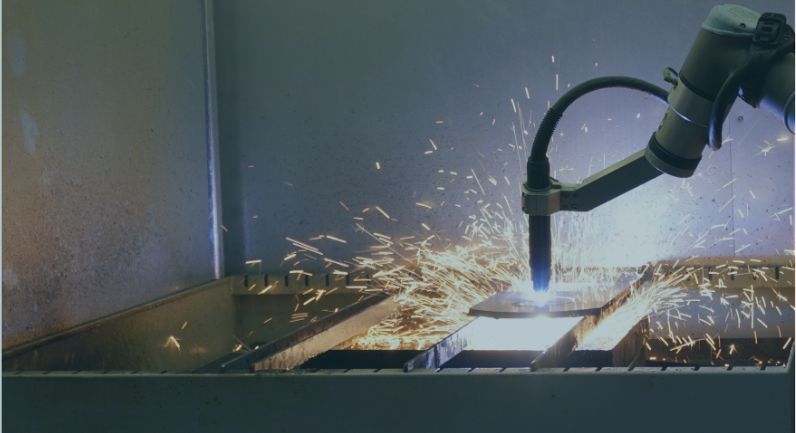
Cobot plasma cutting is plasma cutting performed by a collaborative robot, or cobot, instead of a person holding a torch or a fixed CNC table. A plasma torch is mounted to the cobot’s arm, and software controls the path, speed, and cutting parameters, producing a repeatable, precise cut without a human guiding the torch by hand. Unlike traditional industrial robots, cobots are designed to work safely alongside people. They don’t need the safety cages or dedicated footprint that older robotic systems require, which is a big part of why they’ve become practical for small and mid-sized fabrication shops rather than just large manufacturers.
How It Differs From Manual and CNC Cutting
Manual plasma cutting relies entirely on the operator’s hand and eye. It’s flexible and requires no setup, but accuracy and edge quality vary from cut to cut and from person to person, and it takes an experienced operator to do it well consistently.
CNC plasma cutting automates the cut using a fixed table and a preprogrammed path, usually from a CAD file. It’s very precise for flat, repetitive work, but the part has to come to the machine, and the table itself takes up a fixed footprint in the shop.
Cobot plasma cutting sits between the two. It automates the cut like a CNC system does, but the cobot can be moved to the part, or the part fixtured around the cobot, which makes it a better fit for pipes, tubes, curved or formed sheet metal, and other non-flat geometry a CNC table physically can’t cut, or for shops that don’t have the volume or space to justify a dedicated CNC table. For a closer look at how a cobot actually produces a cut, see our guide on how cobot plasma cutting works.
Why Shops Are Adopting It
The most common reason isn’t really about the cutting itself. It’s about where the people doing the cutting come from. In most fabrication shops, the people skilled enough to do good manual cutting and weld prep are the same people who should be welding. Every hour spent hand-cutting bevels or cleaning up rough edges is an hour not spent on the welding work that actually needs that skill.
Automating the cutting step doesn’t just speed up the cut. It frees up the people who were doing it, and it removes the variation that comes from cutting quality depending on who’s holding the torch that day. It also means those skilled people spend their time on the welding work that actually needs their judgment, rather than on cutting and prep that a cobot can handle just as consistently, shift after shift.
What a Cobot Plasma Cutting Setup Can Do
A cobot plasma cutting system, like Smooth Robotics’ SmoothCut, typically handles:
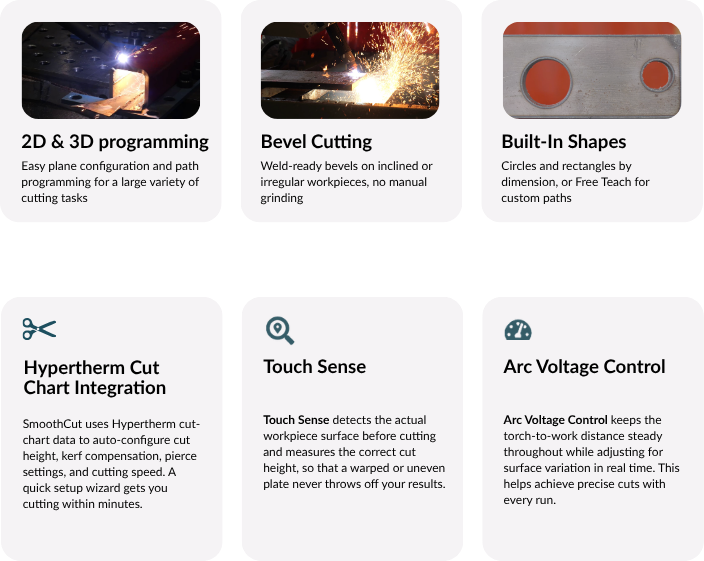
- General cutting – straight cuts and profiles, repeated with the same quality on every part.
- Bevel cutting – weld-ready bevels produced by selecting material, thickness, and angle, rather than grinding a bevel by hand.
- Repetitive shapes – circles, rectangles, slots, and holes cut by entering dimensions, useful for parts that need the same cutout again and again.
- Custom geometry – shapes taught directly on the workpiece for one-off parts, pipes, tubes, or curved and formed sheet metal that doesn’t fit a standard shape, with a 3D view that lets you inspect the lead-in and lead-out on the cut path before you cut.
- Consistent cut quality on uneven material – automatic torch height compensation keeps the cut clean even when the plate isn’t perfectly flat.
- Cut Chart Integration – pulls cut height, kerf compensation, and speed directly from certified cut charts, using Hypertherm’s single-piece SmartSYNC cartridges, which identify themselves automatically so the correct settings are always in use. No manual lookup, no entry errors.
Full breakdown of these features in our product overview.
What Hardware Does Cobot Plasma Cutting Run On?
A cobot plasma cutting setup is really two pieces of hardware working together: the collaborative robot arm, and the plasma cutting system it’s paired with. Knowing both before you start evaluating vendors saves a step later.
SmoothCut runs on Universal Robots cobots, paired with Hypertherm’s Powermax SYNC plasma systems (45, 65, 85, and 105 amperage models), using SmartSYNC cartridges that identify themselves automatically to the system. The UR8 Long and UR12e are the most common choices, and the right fit for most projects. Smaller UR models can make sense too, depending on the job, especially if you’re bringing the cobot to the workpiece rather than the other way around: a smaller, lighter cobot is easier to carry and reposition than the larger models. If your shop already owns a UR cobot, or already runs Hypertherm Powermax equipment, that’s a real head start on fit.
Are There Ongoing Consumable Costs to Plan For?
Yes, and it’s worth planning for honestly rather than glossing over. Like any plasma cutting system, cartridges wear and need replacing over the life of the machine. SmoothCut uses Hypertherm’s singlepiece SmartSYNC cartridges, which the system reads automatically, so at least the risk of running the wrong cartridge for the job, and wasting one in the process, is designed out.
Standalone, or Added to an Existing Welding Cobot
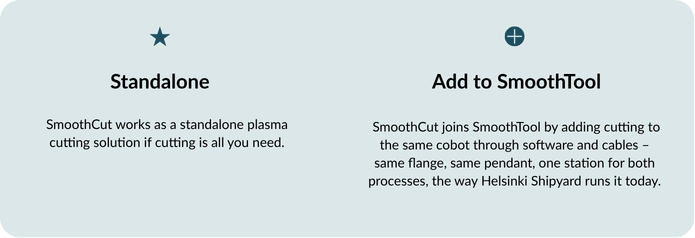
Cobot plasma cutting doesn’t have to be a separate investment from cobot welding. Some shops adopt it standalone, purely to automate cutting. Others already run a cobot for welding and add cutting to the same machine, using the same programming interface for both. Smooth Robotics’ Helsinki Shipyard installation is a real example of this: the shipyard cuts and welds on the same UR12e station, switching torches without moving the part between machines.
Where Cobot Plasma Cutting Isn’t the Right Fit
To be upfront: cobot plasma cutting isn’t the better choice for every shop. If you’re running high-volume, purely flat-sheet cutting from CAD files, a dedicated CNC plasma table is still generally faster and more efficient at that specific job, that’s genuinely what CNC tables are built for. Cobot plasma cutting earns its place in shops with more varied part geometry, lower or mixed cutting volume, or a need to combine cutting with welding on the same station, not as a universal replacement for every cutting method.
See our cobot vs. CNC comparison for a fuller breakdown of where each one wins.
Is Cobot Plasma Cutting Worth It?
That depends mostly on how much manual cutting and weld prep time your shop is currently absorbing, and what that time is worth relative to the cost of automating it. We cover this in detail, including what a real ROI calculation looks like, in our guide to cobot plasma cutting cost and ROI. If you’re comparing cobot cutting specifically against a CNC table, see our cobot vs. CNC plasma cutting comparison.
Ready to look at your own cutting jobs?
SmoothCut is our cobot plasma cutting software for Universal Robots and Hypertherm Powermax SYNC. See what it does and how Helsinki Shipyard uses it, or talk to our experts about your application.
FAQ
Yes, when the system compensates for surface variation and pulls cut parameters from certified cut charts rather than manual estimation. Consistency is often the bigger advantage over manual cutting, not just raw accuracy.
No. Systems built for fabricators, rather than robotics engineers, use the same kind of interface welders are already used to, not robot programming languages.
Not by itself. A cobot can be equipped for welding and cutting and switch between the two, but that requires software and hardware built to support both processes on the same station, as SmoothTool and SmoothCut do together.
A Universal Robots cobot paired with a Hypertherm Powermax SYNC plasma system (45, 65, 85, or 105). The UR8 Long and UR12e are the most common fit, though a smaller cobot can be the better choice if you need to carry it to the workpiece rather than bringing the part to a fixed station. If you already own either the robot or the plasma system, that’s a real advantage going in.
Yes, consumable cartridges wear over time like on any plasma system, and need replacing. SmartSYNC cartridges are read automatically, so at least mismatched or wasted cartridges aren’t part of that cost.