The manufacturing industry is facing a critical challenge that threatens production capacity, quality standards, and growth potential across multiple sectors. This challenge isn’t related to supply chain disruptions or material costs—it’s about people. Specifically, it’s about the severe and growing shortage of skilled welders that has reached crisis levels in both North America and Europe.
The Welding Labor Crisis: Understanding the Scope
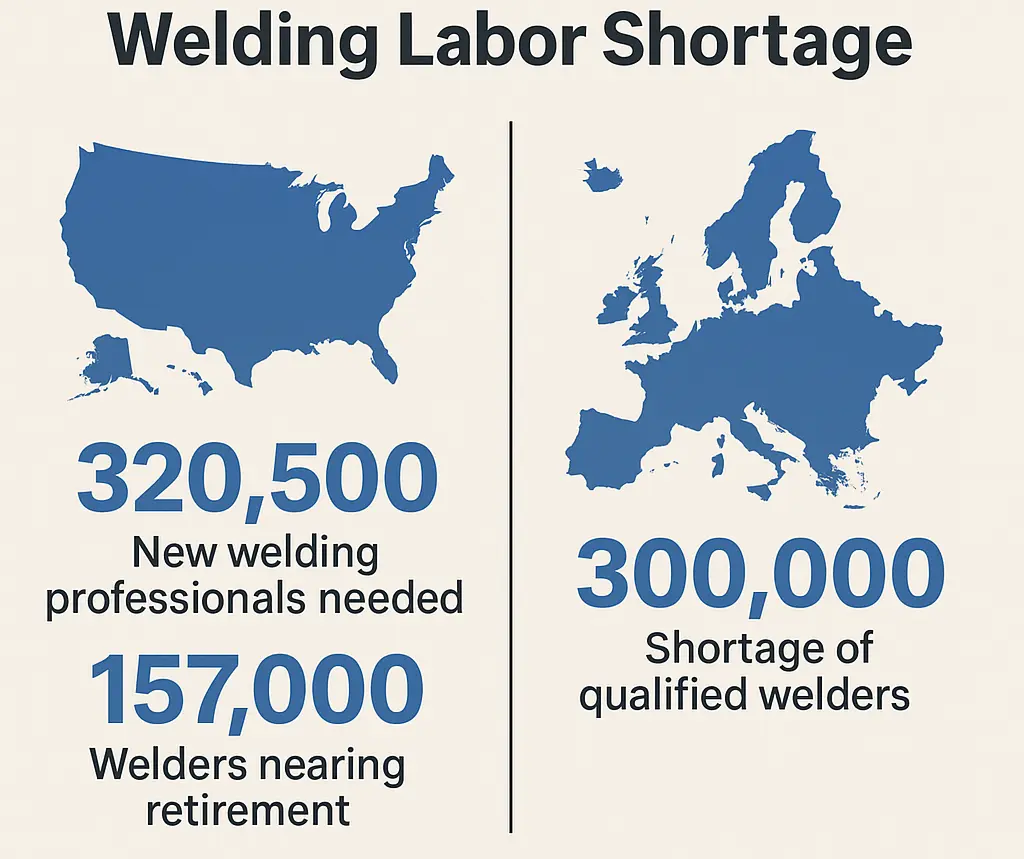
The welding industry is experiencing an unprecedented welding labor crisis that continues to worsen year after year. In the United States, the American Welding Society (AWS) estimates that 320,500 new welding professionals will be needed by 2029, while more than 157,000 current welders are approaching retirement age. This creates a double impact: not only are new positions going unfilled, but existing expertise is rapidly leaving the workforce.
The situation is equally concerning in Europe, where the European Welding Federation (EWF) reports a shortage of around 300,000 qualified welders. These skilled welder shortage statistics paint a troubling picture for manufacturers who rely on welding operations for critical production processes.
Several factors have contributed to this welding labor crisis:
Aging workforce: The average age of welders continues to rise, with many experienced professionals retiring without adequate replacement.
Shifting career interests: Younger generations have shown less interest in pursuing trades like welding, often preferring technology or service-oriented careers.
Training gaps: Traditional welding education hasn’t kept pace with modern manufacturing needs, creating a skills mismatch.
Perception challenges: Welding is often incorrectly perceived as a low-tech, physically demanding job with limited career potential.
Increasing demand: Despite the labor shortage, demand for welding continues to grow across industries like automotive, construction, aerospace, and energy.
For many manufacturers, this welding workforce challenge has led to significant business impacts: production delays, quality inconsistencies, increased overtime costs, and even the inability to accept new contracts. Traditional solutions like raising wages, expanding recruitment efforts, or outsourcing have provided only limited relief while often increasing operational costs.
Automation as a Strategic Solution to the Welder Shortage
Faced with this persistent welding labor crisis, forward-thinking manufacturers are turning to automation—specifically collaborative robot (cobot) technology—as a strategic solution rather than a temporary fix.
Unlike traditional industrial robots that completely replace human workers, collaborative robots are designed to work alongside skilled welders, augmenting their capabilities and productivity. This human-robot collaboration creates a powerful approach to addressing the welder shortage while maintaining quality and flexibility.
How Cobot Automation Addresses the Welder Shortage
Automation solutions for labor shortage in welding offer multiple pathways to mitigate the impact of welder shortages:
1. Multiplying Welder Productivity
Perhaps the most immediate benefit of welding automation is the ability to multiply the productivity of existing welders. When equipped with a cobot assistant, a single skilled welder can oversee multiple welding operations simultaneously, effectively doubling or tripling their output.
The cobot handles the repetitive, physically demanding aspects of welding—maintaining consistent torch angles, travel speeds, and patterns—while the human welder focuses on setup, quality control, and managing more complex aspects of the operation. This productivity multiplication directly reduces the number of additional welders needed to meet production targets.
2. Reducing the Skill Barrier for New Welders
Traditional welding requires years of training and experience to master. Cobots dramatically reduce this learning curve by handling the precise execution of welding techniques. This allows companies to hire and train new welders more quickly, focusing their training on programming and overseeing the cobots rather than developing years of manual welding muscle memory.
With no-code programming interfaces like SmoothTool, even welders with limited technical background can quickly learn to program complex welding paths. This accessibility opens welding careers to a broader talent pool, helping to address the recruitment challenges that have contributed to the welder shortage.
3. Retaining Experienced Welders Longer
Many experienced welders leave the profession earlier than they might prefer due to the physical demands and strain of manual welding. Cobot automation reduces this physical burden by handling the repetitive motions and awkward positions that contribute to fatigue and injury.
By transitioning experienced welders into robot programming and oversight roles, companies can extend these valuable employees’ careers, retaining their expertise and judgment while reducing physical strain. This approach helps bridge the gap between retiring welders and incoming talent, effectively supplementing welding workforce capacity.
4. Improving Working Conditions to Attract New Talent
The perception of welding as a physically demanding, uncomfortable job has contributed to recruitment challenges. Cobot welding systems transform the welding environment, reducing exposure to heat, fumes, and ergonomic strain while introducing high-tech elements that appeal to technology-oriented younger workers.
This modernized work environment helps companies attract new talent who might otherwise not consider welding as a career path. The opportunity to work with advanced robotics technology while developing valuable automation skills creates a more appealing career trajectory, addressing a key aspect of the welding labor crisis.
Implementing Cobot Welding: Practical Approaches for Manufacturers
While the benefits of cobot welding for addressing welder shortage solutions are clear, successful implementation requires a strategic approach. Here’s how manufacturers can effectively deploy cobot welding solutions to supplement their welding workforce:
Start with High-Volume, Repeatable Applications
The most immediate productivity gains come from automating high-volume, repeatable welding tasks. These applications provide the fastest return on investment while freeing skilled welders to focus on more complex, variable work that still requires human judgment and dexterity.
Ideal starter applications include:
Long, straight welds
Repetitive joint configurations
Components with consistent dimensions
Production runs with minimal changeover
By starting with these applications, companies can achieve quick wins that build confidence in cobot technology while developing internal expertise for more advanced applications.
Invest in User-Friendly Cobot Systems
Not all cobot welding systems are created equal when it comes to ease of use. To effectively address welder shortages, look for systems specifically designed to be programmed and operated by welders rather than robotics specialists.
Key features to prioritize include:
Intuitive, graphical programming interfaces
Hand-guiding capabilities for teaching weld paths
Pre-programmed templates for common weld types
Simple integration with existing welding power sources
SmoothTool’s welding software exemplifies this approach, allowing welders to program complex paths through simple, intuitive interfaces without requiring coding knowledge—a key consideration when implementing automation solutions for labor shortage.
Develop a Hybrid Workforce Strategy
Rather than viewing cobots as replacements for welders, successful manufacturers develop hybrid workforce strategies that combine the strengths of both humans and robots. This approach typically involves:
Upskilling existing welders to program and oversee cobot operations
Creating specialized roles that leverage each welder’s strengths
Developing career pathways that incorporate both manual and automated welding skills
Establishing mentorship programs where experienced welders train newer employees on both traditional techniques and cobot programming
This hybrid approach maximizes the value of each welder while creating more appealing career paths that can help with recruitment and retention, effectively supplementing welding workforce capabilities.
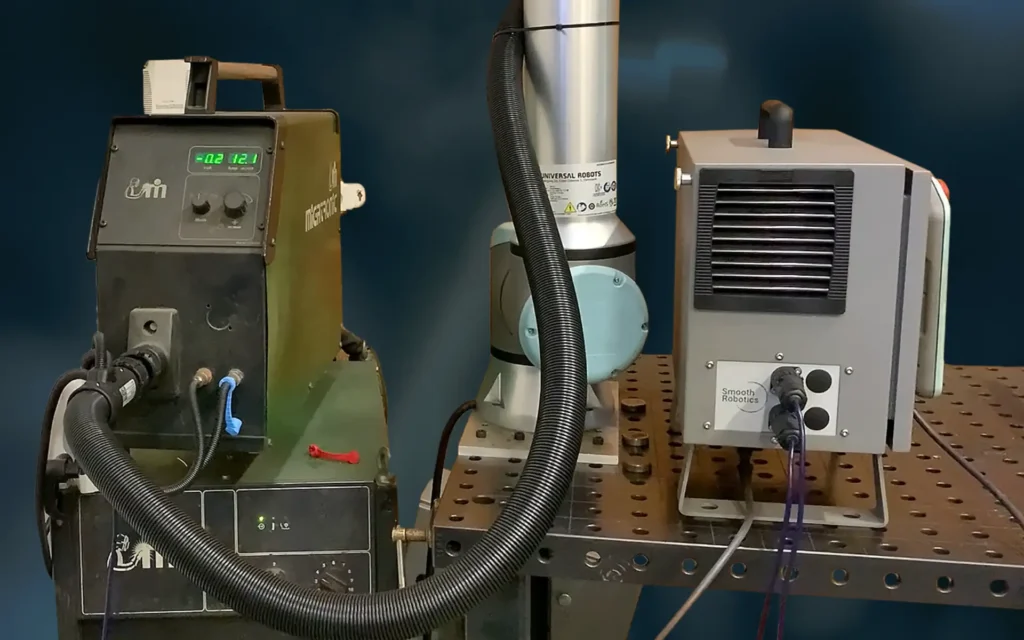
Modern cobot welding solutions like SmoothTool are designed to work with virtually any welding power source, allowing companies to leverage their existing equipment investments while adding automation capabilities. This approach significantly reduces the capital expenditure required to begin addressing welder shortages through automation.
Case Studies: Real-World Welder Shortage Solutions
The impact of cobot welding on addressing welder shortages is best illustrated through real-world examples. These case studies demonstrate how manufacturers across different industries have successfully implemented automation solutions for labor shortage to overcome welding workforce challenges.
Alusteel Slashes Production Time by 47% with Cobot Welding
Danish metal fabrication company Alusteel was facing the global skilled welder shortage that has impacted manufacturers worldwide. With a diverse customer base requiring small batches of precision components—including parts for some of Denmark’s largest robot companies—they needed a solution that would maintain quality while addressing their welding labor crisis. By implementing cobot welding technology with SmoothTool software, they were able to:
Reduce production time by 47% on a recent project, completing 30 precision-welded pieces in just 11 hours instead of the 21 hours required for manual welding
Enable their skilled welders to program the cobots using their expertise, without requiring robotics knowledge
Free up welders to focus on complex welds requiring special skills while the cobots handled repetitive tasks
Improve working conditions by reducing exposure to welding fumes and eliminating stressful postures
Achieve consistent, high-quality welds with perfect precision every time
“For us, this means that a welder and a cobot are really like having three men at work. It’s really effective,” explains Mads Milling, Alusteel’s founder. The company found that each cobot effectively tripled their welding workforce capacity, allowing them to meet growing customer demand despite the tight labor market—a powerful example of welder shortage solutions in action.
What makes this automation solution for labor shortage particularly noteworthy is how it transformed the welders’ roles rather than replacing them. Experienced welder Boguslaw Hara now uses his 15 years of expertise to program the cobot through an intuitive interface, teaching the robot to replicate his skilled technique. This approach not only addresses the immediate productivity needs but also creates a more appealing work environment that helps with supplementing welding workforce capacity while improving retention and recruitment.
Shun Fu Enterprise Reduces Welding Time by 80% with Cobot Automation
Shun Fu Enterprise, a family-owned welding business in Changhua City, Taiwan, faced a critical skilled welder shortage that threatened their growth and sustainability. Having built a reputation for high-quality welding services over nearly a decade, the company found itself unable to meet growing demand while relying solely on its founder, Mr. Lin Sheng-Wei, and one family member—a microcosm of the global welding labor crisis.
The challenge was compounded by their specialization in small-batch, diverse production runs, each requiring time-consuming manual adjustments. By implementing a Universal Robots UR10e cobot integrated with SmoothTool welding software, they were able to:
Reduce welding operation time by approximately 80%, dramatically increasing production capacity
Address their immediate welder shortage without compromising their reputation for quality
Enable the owner to focus on business growth and customer relationships rather than repetitive welding tasks
Maintain consistent, high-quality output across all projects regardless of complexity
Create a more appealing work environment that could attract younger talent to the welding profession
“Within three weeks, I was able to operate the cobot independently,” says Mr. Lin. “The intuitive interface of SmoothTool meant I didn’t need to write any code—just follow simple instructions to get the desired results. This was especially important for our small-batch and diverse production needs.”
What makes this automation solution for labor shortage particularly impressive is the rapid implementation timeline. In just three weeks, a traditional welder with no prior robotics experience was able to independently operate the system, demonstrating how accessible these welder shortage solutions have become. “The biggest change has been the time savings. Once the cobot’s working path is set, it handles the rest of the process autonomously,” Mr. Lin explains.
Beyond addressing their immediate workforce challenges, Shun Fu sees the cobot as a way to elevate the entire profession. By improving the work environment and simplifying operations, they hope to make welding more appealing to younger generations—a forward-thinking approach to supplementing welding workforce capacity for the long term.
Overcoming Implementation Challenges
While cobot welding offers powerful solutions to welder shortages, successful implementation requires addressing several common challenges:
Resistance to Change
Existing welders may initially be skeptical or resistant to automation technology, fearing job displacement. Successful implementations address this by:
Clearly communicating that cobots will supplement, not replace, skilled welders
Involving welders in the selection and implementation process
Providing comprehensive training and support
Emphasizing how automation can make their jobs less physically demanding and more technically interesting
When welders see cobots as tools that enhance their capabilities rather than threats to their employment, adoption proceeds much more smoothly, making it easier to implement welder shortage solutions.
Application Selection
Not every welding application is equally suitable for cobot automation, especially in the early stages of adoption. Companies should:
Begin with applications that offer the clearest path to success
Gradually expand to more complex applications as expertise develops
Maintain realistic expectations about which tasks are best suited for automation versus manual welding
Develop clear criteria for evaluating which jobs to automate next
This measured approach builds confidence and expertise while delivering meaningful productivity improvements, essential for addressing the welding labor crisis.
Integration with Existing Processes
Cobot welding cells need to integrate smoothly with existing production workflows to deliver maximum value. Considerations include:
Material handling and part presentation
Quality control procedures
Production scheduling
Maintenance routines
Data collection and analysis
Taking a holistic view of the entire process, rather than focusing solely on the welding operation itself, ensures that cobot implementation delivers the expected productivity gains when supplementing welding workforce capacity.
The Future of Welding Workforce Development
As cobot welding technology continues to evolve, it’s reshaping approaches to welding workforce development in ways that directly address the skilled welder shortage:
New Training Paradigms
Traditional welding education focused primarily on developing manual skills through extensive practice. The rise of cobot welding is driving new training approaches that combine:
Fundamental welding knowledge (metallurgy, joint design, weld quality assessment)
Cobot programming and operation skills
Process optimization and troubleshooting
Collaborative work methods
These new training paradigms can produce effective welding professionals in less time, helping to address the pipeline challenges that contribute to welder shortages.
Evolving Career Paths
Cobot technology is creating new career paths within the welding profession that may appeal to candidates who wouldn’t consider traditional welding roles:
Cobot programmers who specialize in optimizing automated welding processes
Welding automation technicians who maintain and troubleshoot systems
Hybrid welders who combine manual skills with automation oversight
Welding process engineers who design optimal human-robot collaborative workflows
These technology-enhanced career paths offer growth opportunities that can help attract and retain talent in the welding industry, addressing a key aspect of the welding labor crisis.
Changing Skill Requirements
As cobot adoption increases, the skill profile of the ideal welding professional is evolving to include:
Stronger problem-solving and analytical abilities
Basic understanding of robotics and automation principles
Digital literacy and comfort with technology interfaces
Ability to optimize processes and identify automation opportunities
This evolution opens welding careers to individuals with different aptitudes and interests, potentially expanding the talent pool beyond traditional sources and helping to address skilled welder shortage challenges.
Conclusion: A Strategic Response to the Welding Labor Crisis
The global shortage of skilled welders represents one of the most significant challenges facing manufacturing today. With hundreds of thousands of positions unfilled and demand continuing to grow, traditional approaches to recruitment and retention alone cannot solve the problem.
Cobot welding automation offers a strategic response to this welding labor crisis—not by replacing welders, but by multiplying their productivity, extending their careers, reducing barriers to entry, and creating more appealing work environments. This approach addresses both the immediate capacity constraints and the longer-term workforce development challenges.
For manufacturers struggling with welder shortages, the question is no longer whether to adopt automation, but how to implement it most effectively. By starting with the right applications, selecting user-friendly systems, developing hybrid workforce strategies, and leveraging cost-effective retrofitting approaches, companies of all sizes can begin addressing their welding capacity challenges.
The future of welding lies not in choosing between humans or robots, but in creating effective collaborations between skilled welders and cobot assistants. This collaborative approach represents the most promising path forward for an industry essential to modern manufacturing but challenged by persistent workforce shortages.
Ready to explore how cobot welding can help address your welder shortage challenges? Book a free consultation with our experts to discuss your specific needs and opportunities.