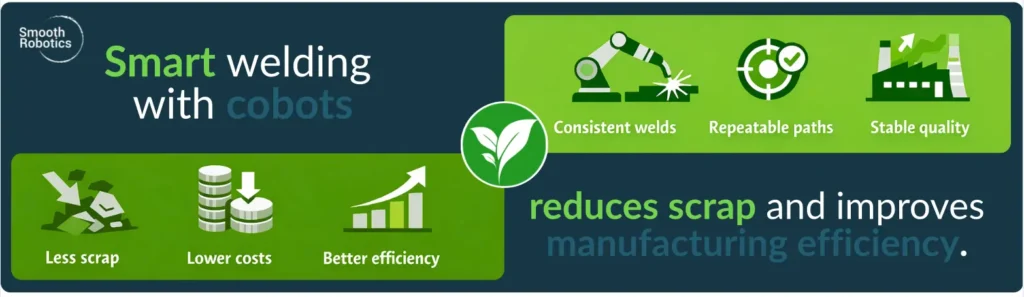
Sustainability is often discussed as a strategic goal in modern manufacturing. However, for many production teams, eco-efficient production becomes meaningful when it translates into less waste, fewer mistakes, and more efficient processes.
In welding operations, even small errors can quickly become expensive. Rework, scrap metal, and wasted consumables all add up. This is where collaborative robots (cobots) can make a tangible difference.

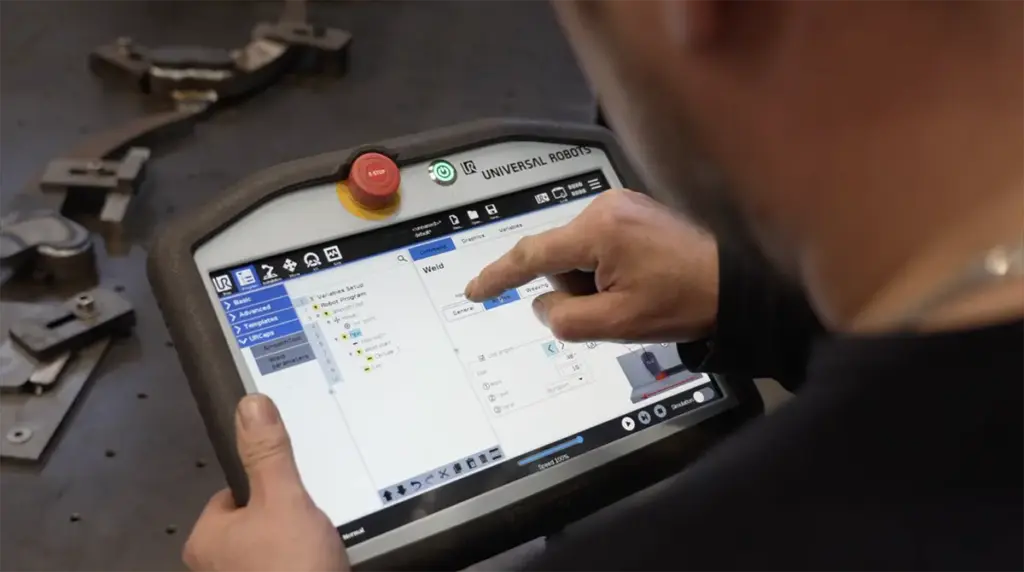
Solutions such as SmoothTool, the cobot welding software developed by Smooth Robotics, further support this process by making it easier for operators to program precise and repeatable weld paths. The software simplifies complex welding programming and helps teams maintain consistent weld quality, reducing the risk of errors that lead to scrap and rework.
Reducing waste where it matters most
One of the biggest challenges in welding is maintaining consistent quality over long production runs. Human welders bring valuable expertise, but fatigue, repetitive work, and complex weld paths can lead to variation and errors.
Collaborative robots help address this challenge by delivering high precision and repeatability. Once programmed, a cobot can execute the same weld path consistently, reducing the likelihood of defects that lead to scrap metal or costly rework.
For manufacturers, this translates into a direct operational benefit:
- Less wasted material
- Fewer rejected parts
- Lower costs related to rework and consumables
According to insights shared by Universal Robots, reducing material waste through precision and repeatability is one of the key ways cobots support more efficient manufacturing processes.
Improving Welding Operations
Robotic welding has long been associated with improved production efficiency. With cobots, this capability becomes more accessible, particularly for small and medium-sized manufacturers.
By automating repetitive welding tasks, cobots help stabilize production output and maintain consistent quality across batches. A A recent academic research in MDPI Sustainability Academic on robotic welding stations also shows that optimized robot programming and motion paths can significantly improve process efficiency while reducing unnecessary rework and material waste.
Instead of replacing welders, cobots typically take over the most repetitive and physically demanding tasks, allowing skilled operators to focus on programming, quality control, and supervision.
Tools like SmoothTool enable welders to quickly generate advanced welding paths through an intuitive interface, without requiring deep robot programming expertise. This approach allows manufacturers to automate repetitive welds faster while maintaining high precision and productivity.
A practical approach to Sustainability
In many cases, sustainability in manufacturing does not come from a single breakthrough technology. Instead, it comes from incremental improvements that reduce waste and improve efficiency across the production process.
In welding operations, collaborative robots contribute to this progress by helping manufacturers:
- Reduce scrap metal and material waste
- Minimize costly rework
- Improve process consistency
- Support safer and more sustainable working conditions for welders
By focusing on waste reduction and operational efficiency, cobots demonstrate how sustainability can move from an abstract concept to a practical advantage on the shop floor.